
Commercial lending has a data challenge hiding in plain sight
Commercial lending has a data challenge hiding in plain sight. It's not in the credit model or the servicing platform. It's in the contract.

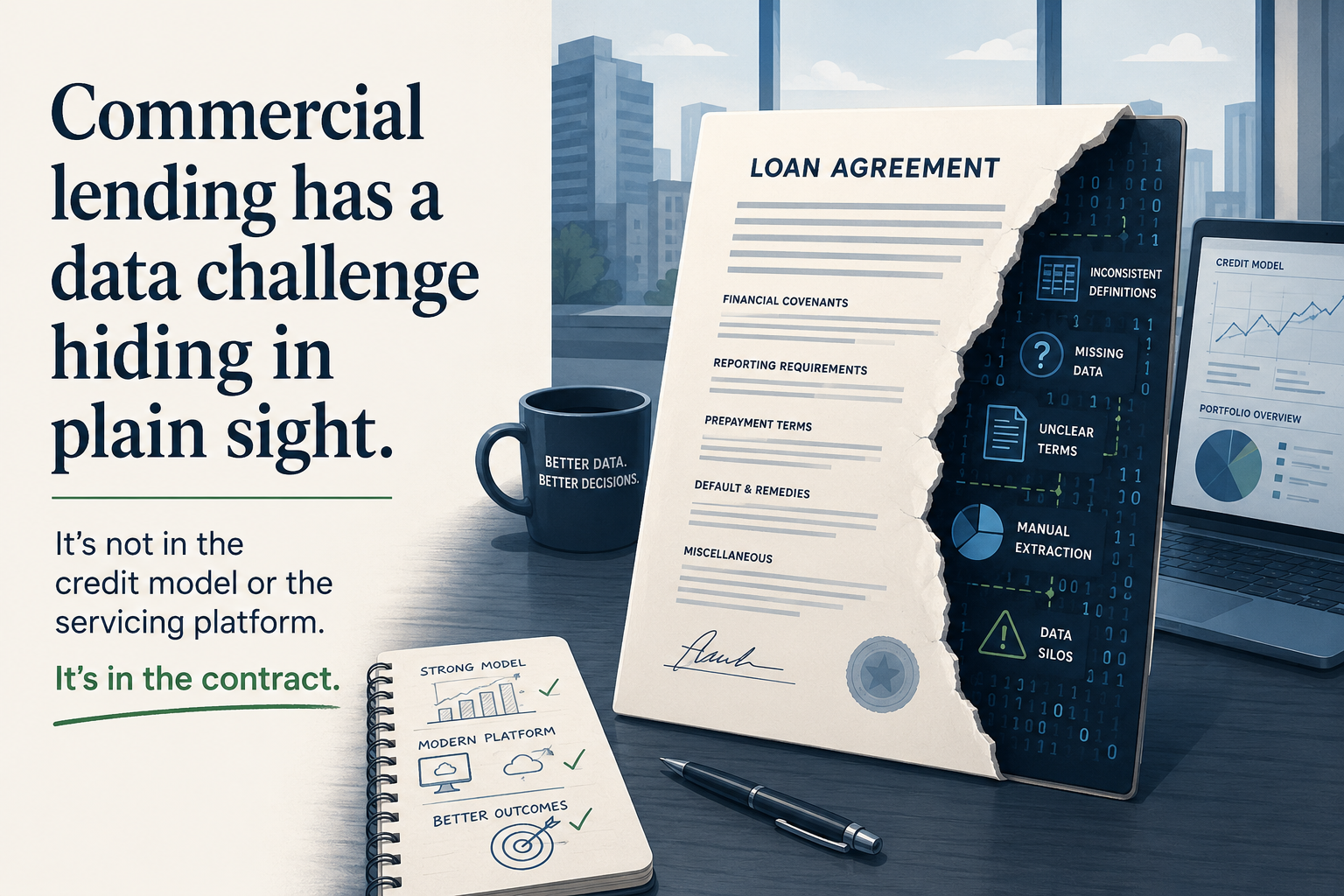
Commercial lending has a data challenge hiding in plain sight. It's not in the credit model or the servicing platform. It's in the contract.
The Loan Market Association (LMA) Edge Conference Report published last month makes a point that deserves wider attention.
It describes a shift that the most effective institutions are making: treating contracts not as static administrative documents, but as structured data that integrates directly with origination, servicing and risk systems.
Most commercial lending operations have invested heavily in their origination infrastructure - credit decisioning tools, automated affordability assessment, digital onboarding. The data quality at the front end of the lending process has improved substantially.
But then the deal gets approved, and the contract enters a different world.
Key terms - pricing, covenants, collateral conditions, maturity dates - are captured in a document. A Word file, a PDF, a template in a shared drive. Structured in a way that doesn't make sense to a downstream system to read, monitor, or act on without human intervention.
So those terms get re-entered. Into the servicing system. Into the covenant monitoring tool. Into the CRM. Each re-entry is a potential error. Each is a delay. Each is a step that relies on a person rather than a process.
The LMA report identifies this: when commercial terms are captured inconsistently across term sheets, legal documents and internal systems, the potential for misalignment increases - with consequences for covenant monitoring, pricing implementation, and reporting.
This is not a new problem. What is new is that it is becoming more and more unsustainable.
Lending volumes are growing. Regulatory expectations on traceability and auditability are rising. The cost of manual reconciliation - in time, in errors, in risk - is compounding.
The institutions getting ahead of this are the ones treating it as a data architecture question, not a legal operations question.
The contract is not the end of the data trail. It should be part of it.
Read the full report here: https://www.lma.eu.com/news-publications
Subscribe to our email newsletter